バナー
ホーム

温度試験装置

温度試験装置

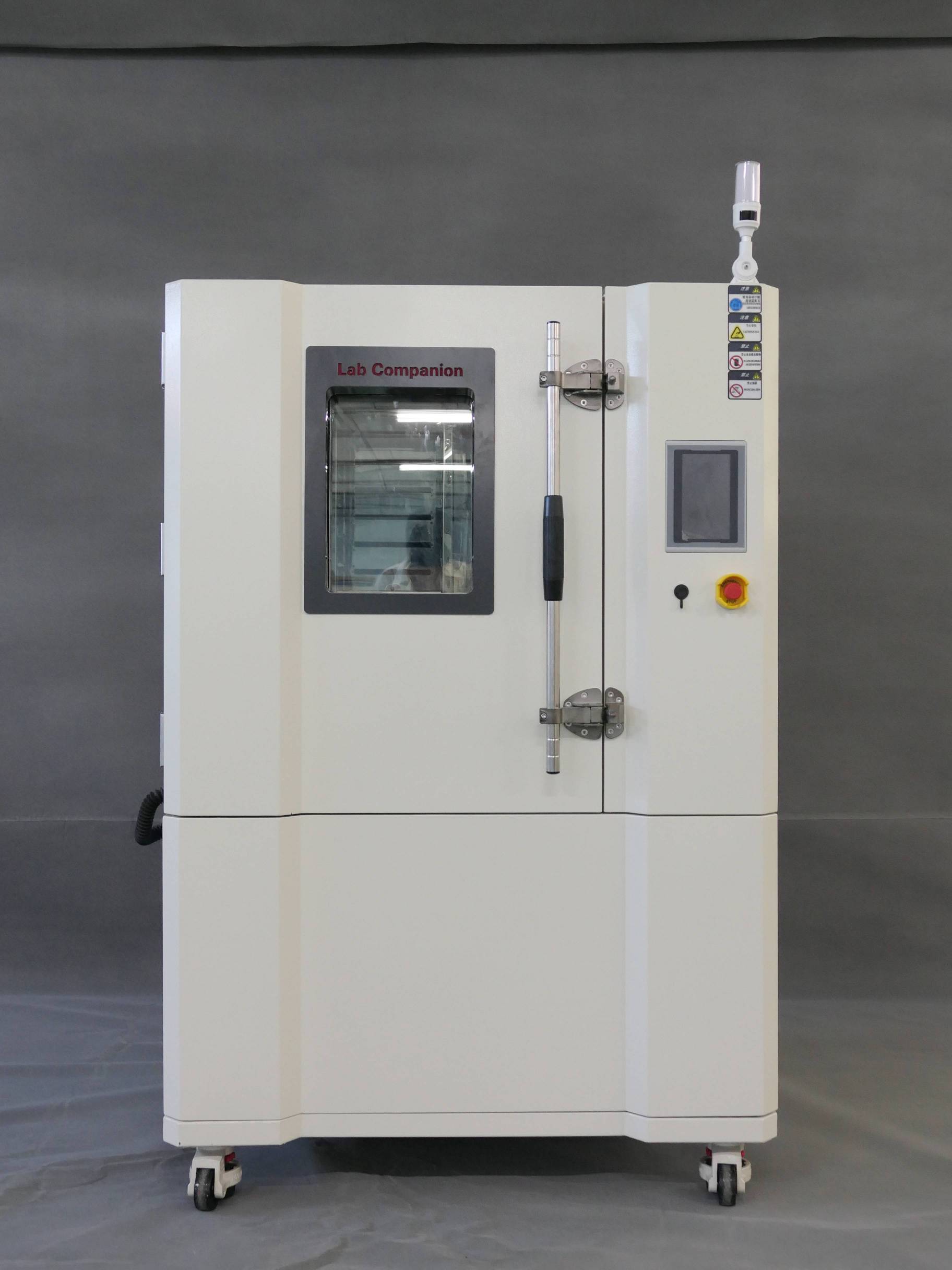
  • Small Rapid Temperature Change (Wet Heat) Test Chamber
    Nov 01, 2025
    In response to the testing and R&D requirements of electronic components such as semiconductors and automotive electronics, Lab Companion has developed a smaller capacity small rapid temperature change (wet heat) test chamber. While maintaining the advantages of standard rapid temperature change test chambers, it can also meet the needs of customers who have requirements for space size, with a single-phase 220VAC voltage specification. It can also meet the equipment usage requirements of customers in civilian office areas such as research institutions and universities. Its main features are as follows: 1. It has powerful heating and cooling performance 2. Heating rate: 15℃/min; Cooling rate: 15℃/min 3. (Temperature range: -45℃ to +155℃) 4. Single-phase 220VAC, meeting the electricity demands of more customers 5. Single-phase 220VAC, suitable for industrial and civil power supply specifications, can meet the equipment power demands of customers in civil office areas such as research institutions and universities. 6. The body is small and exquisite, with a compact structure and easy to move 7. The miniaturized structure design of the test chamber can effectively save configuration space. 8. The inner tank volume is 100L, the width is 600mm, the depth is less than 1400mm, and the product volume is less than 1.1m ³. It is suitable for the vast majority of residential and commercial elevators in China (GB/T7025.1). 9. The standard universal wheels enable the product to move freely at the installation site. 10. Standard air-cooled specification is provided, facilitating the movement and installation of the product 11. At the same time, it saves customers the cost and space of configuring cooling towers. 12. A more ergonomic operation touch screen design 13. Through the multi-angle adjustment of the touch screen, it can meet the operation needs and provide the best field of vision for users of different heights, making it more convenient and comfortable. 14. Energy-saving cold output temperature and humidity control system, with dual PID and water vapor partial pressure control, features mature technology and extremely high precision. 15. Network control and data acquisition can be carried out through the interface (RS-485/GPIB/Web Lan/RS-232C). 16. It is standard-equipped with left and right cable holes (50mm), which facilitates the connection of power on the sample and the conduct of multiple measurements. 17. The controller adopts a color LCD touch screen, which is simple and convenient to operate 18. Through the controller, two control methods, fixed value and program, can be selected to adapt to different applications. 19. The program control can be set to 100 modes, with 99 steps for each mode. Repeat the loop up to 999 times. 20. Multiple languages can be easily switched (Simplified Chinese, English), and test data can be stored on a USB flash drive.
    続きを読む
  • Flame-retardant PP Materials in Industry Working Principle
    Oct 27, 2025
    Polypropylene (PP) itself is a highly flammable hydrocarbon with a limiting oxygen index (LOI) of only 17.8%. It will continue to burn even after being removed from the fire source. The core principle of flame-retardant PP is to interrupt or delay its combustion cycle through physical and chemical means. Combustion requires the simultaneous existence of three elements: combustible material, heat and oxygen. The function of flame retardants is to destroy this "burning triangle".   In industry, flame retardancy is mainly achieved by adding flame retardants to PP. Different types of flame retardants function through the following mechanisms: 1. Gas-phase flame retardant mechanism This is one of the most common mechanisms, especially applicable to traditional halogen-based flame retardants. When flame retardants are heated and decomposed, they can capture the free radicals (such as H· and HO·) that maintain the combustion chain reaction in the combustion reaction zone (flame), causing their concentrations to drop sharply and thus interrupting the combustion. 2. Condensed phase flame retardant mechanism This is the most mainstream mechanism of halogen-free flame-retardant PP. Flame retardants promote the formation of a uniform and dense carbon layer on the surface of polymers. This layer of carbon has three major functions. The first step is to prevent external heat from entering the interior of the polymer. Secondly, it prevents the escape of flammable gases inside and the entry of external oxygen. Finally, it inhibits the further pyrolysis of the polymer and the generation of smoke. When a fire occurs, the acid source promotes the dehydration, cross-linking and carbonization of the carbon source. Meanwhile, the large amount of gas produced by the decomposition of the gas source causes the softened carbon layer to expand, eventually forming a porous, dense and strong foam carbon layer, which protects the underlying PP like "armor". 3. Cooling/heat absorption mechanism Flame retardants absorb a large amount of heat during the decomposition process, reducing the surface temperature of polymers and making it difficult for them to continuously pyrolyze and produce flammable gases. Typical representatives include aluminium hydroxide (ATH) and magnesium hydroxide (MH). When they decompose, they absorb a large amount of heat (endothermic reaction) and release water vapor. The water vapor can not only dilute flammable gases but also play a cooling role. 4. Dilution mechanism Flame retardants decompose to produce a large amount of non-flammable gases (such as water vapor and CO₂, etc.), which can dilute the concentration of flammable gases and oxygen near the polymer surface, making combustion unsustainable. Both the gas sources of metal hydroxides and intumescent flame retardants have this function.   In conclusion, the working principle of flame-retardant PP in industry is a complex process involving the synergy of multiple mechanisms. Modern flame-retardant PP technology is developing towards halogen-free, low smoke, low toxicity and high efficiency. Among them, the condensed phase flame-retardant mechanism represented by intumescent flame retardants (IFR) is the core of current research and application. By carefully designing flame-retardant formulas, the best balance can be achieved among flame-retardant efficiency, material mechanical properties, processing performance and cost.
    続きを読む

  • How is over-temperature protection carried out in a temperature test chamber?
    Oct 23, 2025
    The over-temperature protection of the temperature test chamber is a multi-level and multi-redundant safety system. Its core purpose is to prevent the temperature inside the chamber from rising out of control due to equipment failure, thereby protecting the safety of the test samples, the test chamber itself and the laboratory environment.   The protection system usually consists of the following key parts working together: 1. Sensor: The main sensor is used for the normal temperature control of the test chamber and provides feedback signals to the main controller. An independent over-temperature protection sensor is the key to a safety system. It is a temperature-sensing element independent of the main control temperature system (usually a platinum resistance or thermocouple), which is placed by strategically at the position within the box that best represents the risk of overheating (such as near the heater outlet or on the top of the working chamber). Its sole task is to monitor over-temperature. 2. Processing unit: The main controller receives signals from the main sensor and executes the set temperature program. The independent over-temperature protector, as an independent hardware device, is specifically designed to receive and process the signals from the over-temperature protection sensor. It does not rely on the main controller. Even if the main controller crashes or experiences a serious malfunction, it can still operate normally. 3. Actuator: The main controller controls the on and off of the heater and the cooler. The safety relay/solid-state relay receives the signal sent by the over-temperature protector and directly cuts off the power supply circuit of the heater. This is the final execution action.   The over-temperature protection of the temperature test chamber is a multi-level, hard-wire connected safety system designed based on the concepts of "redundancy" and "independence". It does not rely on the main control system. Through independent sensors and controllers, when a dangerous temperature is detected, it directly and forcibly cuts off the heating energy and notifies the user through sound and light alarms, thus forming a complete and reliable safety closed loop.
    続きを読む
  • エアバルブによる試験室内の温度バランスの原理
    Sep 22, 2025
    その基本原理は、「加熱-測定-制御」という閉ループの負帰還システムです。簡単に言えば、ボックス内の加熱素子の出力を正確に制御することで、外部環境による熱放散を抑え、周囲温度よりも高い一定の試験温度を維持することです。エアバルブが温度を安定させるプロセスは、動的かつ継続的に調整される閉ループです。 まず、目標温度を設定します。温度センサーがボックス内の実際の温度をリアルタイムで測定し、その信号をPIDコントローラに送信します。PIDコントローラが誤差値を計算すると、PIDアルゴリズムを用いて誤差値に基づいて調整すべき加熱電力を計算します。このアルゴリズムは3つの要素を考慮します。P(割合):電流誤差はどのくらいですか?誤差が大きいほど、加熱電力の調整範囲が大きくなります。I(積分):一定期間における誤差の蓄積。静的誤差を除去するために使用されます(例えば、常にわずかな偏差がある場合、積分項によって徐々にその誤差の度合いが増し、完全に除去されます)。D(微分):電流誤差の変化率。温度が目標値に急速に近づいている場合、オーバーシュートを防ぐために事前に加熱電力を下げます。3. PID コントローラは、計算された信号を加熱要素の電力コントローラ (ソリッドステート リレー SSR など) に送信し、加熱線に適用される電圧または電流を正確に調整して、発熱を制御します。4. 循環ファンは連続運転し、加熱によって発生した熱を迅速かつ均一に分散させます。同時に、温度センサーの信号変化をコントローラーに迅速にフィードバックすることで、システムの応答時間を向上させます。 エアバルブバランサーは空気量を測定しますが、空気の密度は温度によって変化します。同じ差圧値でも、密度の異なる空気に対応する質量流量または体積流量は異なります。そのため、機器内部のマイクロプロセッサが測定された差圧値に基づいて予め設定された計算式を用いて標準状態における空気量値を正確に算出できるように、温度を既知の固定値に安定させる必要があります。温度が不安定な場合、測定結果は信頼できません。
    続きを読む
  • ラボコンパニオン空冷式機械圧縮冷凍機の動作原理 ラボコンパニオン空冷式機械圧縮冷凍機の動作原理
    Sep 06, 2025
    1.圧縮低温・低圧の冷媒ガスは蒸発器から排出され、コンプレッサーに吸い込まれます。コンプレッサーは、この部分の冷媒ガスに作用し(電気エネルギーを消費します)、激しく圧縮します。冷媒が高温・高圧の過熱蒸気に変化すると、蒸気の温度は周囲温度よりもはるかに高くなり、外部への熱放出に適した状態になります。2. 結露高温高圧の冷媒蒸気は、凝縮器(通常は銅管とアルミニウムフィンで構成されたフィンチューブ型熱交換器)に入ります。ファンの力で周囲の空気が凝縮器のフィンに吹き付けられます。すると、冷媒蒸気は凝縮器内を流れる空気に熱を放出します。冷却によって、冷媒蒸気は徐々に気体状態から中温高圧の液体へと凝縮します。この時点で、熱は冷凍システムから屋外へと放出されます。3. 拡大中温高圧の液冷媒は、絞り装置を通過して狭い流路を流れます。絞り装置は、水道管の開口部を指で塞ぐように、圧力を絞って下げる役割を果たします。冷媒の圧力が急激に低下すると、温度も急激に低下し、低温低圧の気液二相混合物(ミスト)となります。4. 蒸発低温低圧の気液混合液が蒸発器に入り、別のファンがボックス内の空気を冷たい蒸発器フィンを通して循環させます。冷媒液は蒸発器内のフィンを通過する空気の熱を吸収し、急速に蒸発・気化して低温低圧のガスに戻ります。この吸熱により、蒸発器を通過する空気の温度は大幅に低下し、試験室の冷却を実現します。 その後、この低温・低圧のガスは再びコンプレッサーに吸い込まれ、次のサイクルが開始されます。このように、サイクルは無限に繰り返されます。冷凍システムは、ボックス内の熱を継続的に外部へ「移動」させ、ファンを通して大気中に放散します。
    続きを読む

伝言を残す

伝言を残す
弊社の製品にご興味があり、詳細を知りたい場合は、こちらにメッセージを残してください。できるだけ早く返信させていただきます。
提出する

ホーム

製品

ワッツアップ

お問い合わせ